
The Mistake That Costs Resellers Months of Progress
Here’s a pattern that plays out every single week. A new reseller signs up, gets panel access, starts selling credits — and when something breaks, they blame the app. The buffering, the crashed EPG, the failed subscription activation. They assume the front-end application is the problem.
It almost never is.
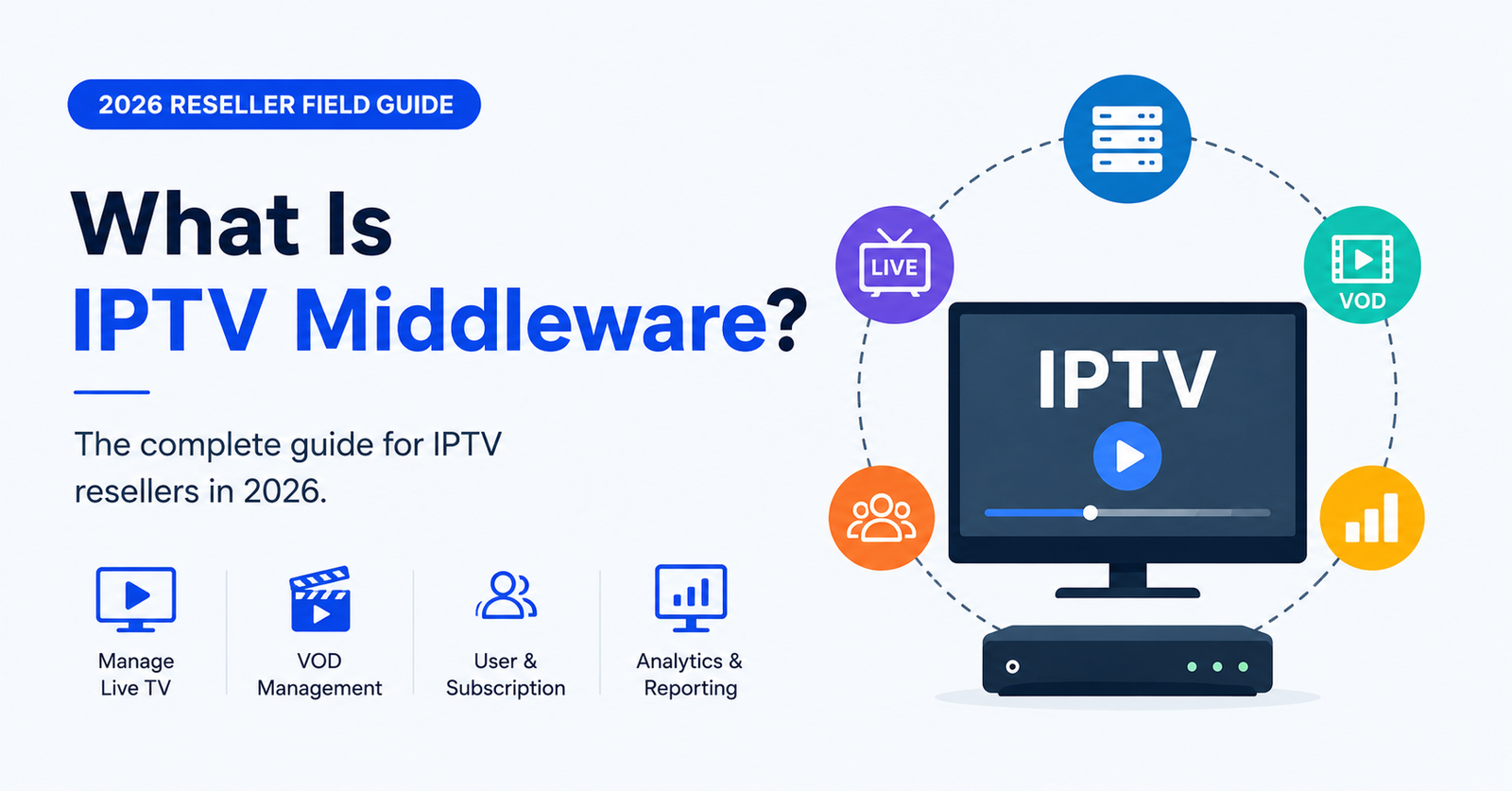
What is IPTV middleware? It’s the invisible layer sitting between the app your subscribers use and the server infrastructure delivering the streams. Middleware is where every meaningful decision happens — credit allocation, EPG scheduling, subscription management, authentication, load distribution across servers. The app is just a window. Middleware is the entire building behind it.
Most people entering the IPTV reseller space in 2026 skip past this understanding entirely. They focus on branding, pricing, finding subscribers. Those things matter. But if you don’t understand what is IPTV middleware and how it governs your operation, you’re flying blind with someone else’s hands on the controls.
Pro Tip: Before spending a single pound on marketing, spend a full week inside your middleware panel. Learn every menu, every toggle, every credit function. UK IPTV Resellers who skip this step spend months troubleshooting problems that a basic understanding of middleware would have prevented in minutes.
What Is IPTV Middleware — And What It Definitely Isn’t
The confusion between middleware and apps is so common it deserves its own section. An IPTV app — whether it runs on a Firestick, Android box, or smart TV — is a client. It receives data, displays channels, and plays streams. That’s it. It doesn’t decide anything.
What is IPTV middleware doing behind that app? Everything else:
- Authenticating each subscriber’s MAC address or login credentials
- Pulling and formatting EPG data across hundreds of channels
- Managing credit balances between master resellers and sub-resellers
- Routing stream requests to the least-loaded server
- Handling subscription activation, renewal, and expiration logic
Think of middleware as the operating system of your IPTV business. The app is just one program running on top of it. When a reseller tells you their “app crashed subscriptions,” what actually happened is the middleware failed — usually an EPG sync error or a credit deduction bug that the app simply reflected.
How Middleware Controls the Credit Economy
If you’re running a reseller operation, credits are currency. And what is IPTV middleware’s role in that economy? It’s the bank.
Every time a reseller activates a subscription, the middleware deducts credits from their balance. When a sub-reseller creates a trial, middleware governs duration, access level, and automatic expiration. Renewal? Middleware. Upgrade from a basic to a premium package? Middleware handles the credit differential.
This is where things get dangerous for operators who haven’t learned their panel properly. A single misconfiguration in the middleware’s credit logic can result in:
- Free subscriptions being issued without credit deduction
- Sub-resellers losing credits for failed activations
- Trial accounts that never expire, draining server resources
| Credit Function | Cheap Middleware | Premium Middleware |
|---|---|---|
| Auto-deduction accuracy | Inconsistent, manual correction needed | Real-time, logged, auditable |
| Sub-reseller credit isolation | Shared pool, prone to conflicts | Individual ledgers per reseller tier |
| Trial management | Basic timer, no auto-expire fallback | Automated expiry with grace period alerts |
| Bulk activation handling | Queues crash above 50 simultaneous | Handles 500+ with load distribution |
If you’ve ever had a sub-reseller message you saying “my credits disappeared,” the answer almost always traces back to a middleware event — not theft, not a hack, but a sync failure or a misconfigured deduction rule.
The EPG Disaster Nobody Talks About
Here’s a real scenario from the field. A reseller running a mid-sized operation — around 400 active subscribers — woke up to a flood of complaints. Every channel was showing the wrong programme guide. Football listed at 3am. News slots showing film schedules from two days ago. Subscribers couldn’t find what they wanted and assumed the service was broken.
What is IPTV middleware’s connection to this? The EPG — Electronic Programme Guide — is parsed, formatted, and distributed entirely by the middleware. It pulls raw XML data from upstream providers, maps it to channel IDs, and pushes it to every connected app. When that parsing engine fails or the XML source changes format without warning, the entire guide collapses.
The reseller in question lost 60 subscribers in 48 hours before identifying the root cause. It wasn’t a server issue. It wasn’t the app. It was a middleware EPG cron job that had silently failed, and nobody was monitoring it.
Pro Tip: Set up an external monitoring ping on your middleware’s EPG refresh endpoint. If the EPG hasn’t updated in 12 hours, you should know about it before your subscribers do. Most middleware platforms support webhook alerts — use them.
Multi-Server Failover — Where Cheap Middleware Falls Apart
Ask any reseller what is IPTV middleware’s most underrated feature, and operators who’ve been through outages will give you the same answer: multi-server failover.
When your primary stream server goes down — and it will, whether from hardware failure, ISP-level blocking, or a DDoS event — your middleware should automatically reroute subscribers to a backup uplink server. Premium middleware does this seamlessly. The subscriber experiences a brief buffer, maybe two seconds, and the stream resumes from another node.
Cheap middleware? It crashes. Or worse, it keeps trying to connect subscribers to the dead server in an endless loop, generating thousands of error logs and making your panel unresponsive for everyone — resellers included.
In 2026, AI-driven ISP blocking has made failover even more critical. ISPs are now using deep packet inspection combined with machine learning to identify and throttle HLS streams in real time. What is IPTV middleware supposed to do about that? Premium platforms rotate DNS resolution paths, switch between CDN endpoints, and distribute load across geographically separated servers — all without the reseller lifting a finger.
- Primary server goes down → Middleware detects within 5 seconds
- Failover triggers → Subscribers rerouted to backup node
- DNS rotation activates → Reduces ISP fingerprinting risk
- Load balancer redistributes → Prevents backup server overload
Without this, you’re one server failure away from losing your entire subscriber base overnight.
Panel Management Is Middleware Management
New resellers often treat the panel as a separate tool from middleware. It isn’t. Your reseller panel is the front-end interface to your middleware. Every button you press, every subscription you activate, every credit you allocate — it’s all executing middleware commands through an API layer.
What is IPTV middleware doing when you click “activate subscription”? It’s running a chain: verify credit balance → deduct credits → generate M3U or Xtream Codes login → assign channel package → set expiration timestamp → log the transaction → push confirmation to the app. That entire sequence is middleware logic.
This is why “learn your panel thoroughly” isn’t casual advice — it’s survival strategy. If you don’t understand what each panel function triggers at the middleware level, you’ll make mistakes that compound:
- Activating the wrong package tier and burning premium credits on basic accounts
- Setting 24-hour trials that the middleware interprets as 24-month subscriptions
- Deleting a sub-reseller account without realising middleware cascades that deletion to all their subscribers
Pro Tip: Before going live with any new reseller account, run five test activations using your own credits. Verify that middleware deduction, package assignment, and expiration all behave exactly as expected. Five test credits can save you five hundred.
HLS Latency and Middleware’s Role in Stream Quality
When subscribers complain about buffering, the instinct is to blame bandwidth or server capacity. And sometimes that’s correct. But what is IPTV middleware’s involvement in stream quality? More than most resellers realise.
Middleware controls how HLS segments are requested, cached, and delivered. It manages the handshake between the subscriber’s app and the stream server, determining buffer sizes, segment lengths, and adaptive bitrate switching. If your middleware is poorly optimised, it might request 10-second HLS segments when the subscriber’s connection can only handle 4-second chunks — resulting in constant rebuffering.
Load balancing is another middleware function that directly impacts quality. When 200 subscribers are watching the same premium sports stream simultaneously, middleware should distribute those connections across multiple servers. Cheap middleware dumps everyone onto one node, saturates it, and every subscriber gets degraded quality.
| Stream Issue | Likely Middleware Cause | Fix |
|---|---|---|
| Constant buffering on one channel | HLS segment size misconfigured | Adjust segment duration in middleware settings |
| All channels buffer at peak times | No load balancing active | Enable round-robin or least-connection distribution |
| Streams work on Wi-Fi, fail on mobile data | DNS poisoning by ISP | Activate middleware DNS rotation |
| EPG loads but streams don’t start | Authentication token expiry too aggressive | Extend token TTL in middleware config |
Scaling Without Understanding Middleware Is Just Growing Your Problems
Every reseller wants more subscribers. Fewer understand that scaling without solid middleware knowledge just amplifies every existing problem. What is IPTV middleware’s role in scaling? It’s the bottleneck or the enabler — depending entirely on how well you’ve configured it.
At 100 subscribers, you can get away with sloppy middleware settings. Misconfigured EPG? Only a handful notice. Credit sync issues? You fix them manually. No failover? You’ve been lucky so far.
At 1,000 subscribers, every one of those problems becomes a crisis. The EPG failure that annoyed 10 people now generates 200 support messages. The credit bug that cost you £5 now costs £500. The single-server setup that “worked fine” collapses during a major sporting event.
- 100 subscribers: Middleware mistakes are inconveniences
- 500 subscribers: Middleware mistakes cause churn
- 1,000+ subscribers: Middleware mistakes destroy operations
Scaling is a middleware challenge first, a marketing challenge second. Before you invest in acquiring your next 500 subscribers, invest time in understanding what is IPTV middleware doing under load, where its limits are, and what breaks first.
Customer Churn Traces Back to Middleware More Than Price
Resellers obsess over pricing. “Am I too expensive? Should I undercut competitors?” But the data tells a different story. Most subscriber churn in IPTV isn’t price-driven — it’s experience-driven. And subscriber experience is controlled almost entirely by middleware.
A subscriber who pays £10 a month and gets reliable streams, accurate EPG, and instant activation will stay for years. A subscriber who pays £5 and deals with broken guides, random logouts, and 48-hour activation delays will leave within a month — and leave a negative review on the way out.
What is IPTV middleware’s impact on retention? It controls every touchpoint that shapes subscriber perception:
- How fast their account activates after payment
- Whether the EPG matches what’s actually broadcasting
- How quickly streams recover after a brief outage
- Whether their login works on multiple devices simultaneously
Pro Tip: Track your middleware’s average activation time. If it takes more than 60 seconds from credit deduction to working subscription, something in your middleware chain needs optimising. Instant activation isn’t a luxury — it’s the baseline expectation in 2026.
ISP Blocking in 2026 — Middleware as Your First Line of Defence
The enforcement landscape has shifted dramatically. ISPs across the UK and Europe are deploying AI-powered deep packet inspection that identifies IPTV streams by traffic pattern, not just DNS lookup. Traditional VPN advice doesn’t cut it anymore for operators running at scale.
What is IPTV middleware doing to counter this? Modern premium middleware platforms include built-in countermeasures:
- DNS rotation — cycling through multiple resolution paths to avoid poisoning
- Protocol obfuscation — wrapping HLS traffic in patterns that resemble standard HTTPS browsing
- Geographic server distribution — routing subscribers through the nearest node to reduce suspicious cross-border traffic patterns
- Automatic uplink switching — when one server path gets throttled, middleware pivots to an alternative without subscriber intervention
Resellers who rely on middleware without these features are increasingly vulnerable. A single ISP-level block can take out your entire subscriber base in one region overnight. And if your middleware doesn’t support failover to backup uplink servers, there’s no recovery path except waiting — while your subscribers move to a competitor.
Frequently Asked Questions
What is IPTV middleware in simple terms?
IPTV middleware is the software layer between the streaming server and the viewer’s app. It handles authentication, channel packaging, EPG delivery, credit management, and subscription logic. Without middleware, the app has no instructions on what to display, who’s authorised, or how long their access lasts. It’s the operational brain of any IPTV service.
Is IPTV middleware the same as an IPTV app?
No. The app is a client that displays content on your screen. Middleware is the backend system that tells the app what content to show, verifies your credentials, manages your subscription status, and routes your stream request to the correct server. They work together, but they serve completely different functions.
Can middleware cause buffering issues?
Yes. Middleware controls HLS segment sizes, adaptive bitrate switching, and load balancing across servers. If the middleware is misconfigured — for example, requesting segment sizes too large for the subscriber’s connection — it directly causes rebuffering. Poor load distribution during peak hours is another common middleware-related buffering cause.
What is IPTV middleware’s role in the credit system?
Middleware processes every credit transaction in a reseller operation. When you activate a subscription, middleware verifies the credit balance, deducts the correct amount, assigns the channel package, and logs the transaction. Credit discrepancies between reseller tiers almost always originate from middleware sync failures rather than external issues.
How does middleware protect against ISP blocking?
Premium middleware platforms include DNS rotation, protocol obfuscation, and automatic server failover. These features cycle resolution paths, disguise streaming traffic patterns, and reroute subscribers when a server gets blocked — all without manual intervention. Budget middleware typically lacks these features, leaving resellers exposed.
Why did my EPG stop working across all channels?
EPG failures are middleware events. The middleware pulls XML programme data from upstream sources on a scheduled cycle. If that source changes format, the cron job fails silently, or the parsing engine encounters an error, the entire guide breaks across every subscriber. Monitoring your middleware’s EPG refresh status prevents this from becoming a mass complaint.
What is IPTV middleware’s biggest difference between cheap and premium tiers?
Multi-server failover. Cheap middleware connects subscribers to a single server with no backup routing. When that server goes down, every subscriber loses access simultaneously. Premium middleware detects failures within seconds and reroutes traffic to backup nodes automatically — the difference between a two-second buffer and a complete service outage.
Should a new reseller learn middleware before selling subscriptions?
Absolutely. Spending a full week learning your middleware panel before going live prevents the most common operational disasters — misconfigured credits, wrong package assignments, broken trials, and cascading account deletions. Five test activations on your own credits will teach you more than any tutorial.
Your IPTV Middleware Success Checklist
- Spend a minimum of one week inside your middleware panel before activating a single paid subscriber — learn every function, not just the activation button.
- Run five test activations using your own credits to verify deduction accuracy, package assignment, and expiration behaviour before onboarding sub-resellers.
- Set up external monitoring on your middleware’s EPG refresh endpoint — if it hasn’t updated in 12 hours, you need an alert, not a subscriber complaint.
- Confirm your middleware supports multi-server failover and test it by deliberately disabling your primary server during a low-traffic window.
- Audit your middleware’s HLS segment configuration — match segment sizes to your average subscriber’s connection speed, not your own fibre line.
- Enable DNS rotation and protocol obfuscation features if your middleware supports them — ISP-level AI blocking in 2026 makes these non-optional.
- Document your middleware’s credit deduction logic and share it with every sub-reseller during onboarding to prevent disputes and confusion.
- Review your middleware logs weekly for silent failures — cron jobs, API timeouts, and authentication errors that don’t generate visible alerts but degrade service quality.
- Before scaling past 500 subscribers, stress-test your middleware’s load balancing by simulating concurrent connections during a peak event scenario.
- Build your operational knowledge base around middleware first — everything else in your reseller business depends on it. Start with the resources at British Seller for reseller-focused infrastructure guidance.