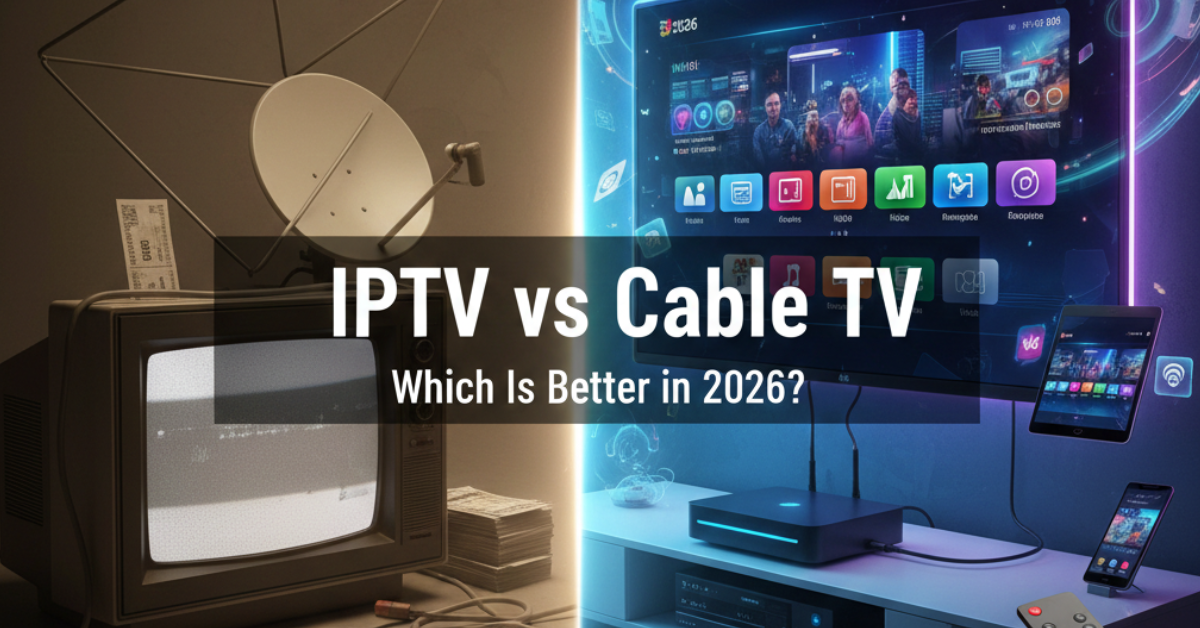

IPTV vs Cable: The Complete 2026 Comparison
The way Americans watch TV has changed dramatically. Millions of families have already cut the cord, and millions more are considering it. If you’re one of them, you’ve likely encountered the IPTV vs Cable debate and wondered which side makes more sense for your home in 2026.
This guide breaks it all down. No sales pitch. No bias. Just a clear, honest comparison so you can make the right decision for your budget, lifestyle, and viewing habits.
Related Read: If you’re exploring IPTV from a business or distribution perspective, start with What Is an IPTV Reseller Panel, a detailed look at how IPTV services are managed and distributed at the provider level.
What Is Cable TV and How Does It Work?
Cable TV has been around since the 1940s. It delivers television channels via a network of physical coaxial cables that run from a central provider hub directly into your home. A set-top box connected to your TV decodes the signal, and you watch what’s on.
You pay a monthly fee to your cable company. They decide which channels are available, how they’re bundled, and what you pay. Contracts are common. Price increases are common too. If you want more channels, you pay more.
For a long time, cable was the only real option for reliable, multi-channel television in most American homes. That is no longer the case.
What Is IPTV and How Is It Different?
IPTV, Internet Protocol Television, delivers the same type of content as cable, but through your internet connection instead of a physical cable infrastructure. Channels are encoded as digital data and streamed to your device in real time.
You don’t need a set-top box from a cable company. You need a compatible device, a smart TV, Android box, Fire TV Stick, smartphone, or tablet, and an IPTV subscription. You enter your login credentials into an IPTV player app, and the channels load.
The content delivery method is fundamentally different, and that difference has a big impact on cost, flexibility, and overall experience.
IPTV vs Cable: A Direct Feature Comparison
Here is a side-by-side look at how the two options stack up across the most important categories.
| Feature | Cable TV | IPTV |
|---|---|---|
| Delivery Method | Physical coaxial cable | Internet connection |
| Live TV Channels | Yes | Yes |
| On-Demand Content | Limited | Extensive (varies by provider) |
| 4K / HD Quality | Available (limited) | Available (varies by provider) |
| Number of Devices | 1-3 (set-top boxes) | Multiple (any compatible device) |
| International Channels | Very limited | Often huge |
| Monthly Cost | $60-$200+ | Varies widely |
| Long-Term Contract | Usually required | Rarely required |
| Internet Dependency | None | Required |
| Setup Complexity | Low (technician installs) | Low to Medium (self-setup) |
| Channel Customization | Fixed bundles | More flexible |
| Customer Support | Provider-controlled | Varies by service |
The table tells a clear story. Cable wins on infrastructure reliability and ease of setup. IPTV wins on cost, flexibility, and content variety.
Cost Comparison: What You Actually Pay
Price is often the primary reason people start looking at alternatives to cable. Let’s look at what the numbers look like in 2026.
| Service Type | Entry-Level Cost | Mid-Tier Cost | Premium Cost |
|---|---|---|---|
| Cable TV (major carriers) | $50-$70/month | $90-$130/month | $150-$200+/month |
| IPTV Subscription | $10-$20/month | $20-$40/month | $40-$60/month |
| Streaming Apps (Netflix, Hulu, etc.) | $8-$18/month each | — | — |
Cable prices have continued to climb. The average American cable bill is now well over $100 per month when you include equipment rental fees, regional sports charges, and broadcast TV surcharges, costs that often appear after you sign up.
IPTV pricing is significantly lower on average. However, price alone should not be the deciding factor. A cheap, unreliable IPTV service isn’t necessarily a bargain. Quality, uptime, and legitimate licensing matter just as much as price.
If you want to explore what different IPTV plans look like in terms of pricing and features, checking a pricing page is a good place to start for understanding what’s available.
Content and Channel Selection
What Cable Offers
Cable packages are bundled. You pay for a set of channels, many of which you may never watch. Want a specific sports network or a foreign language channel? It often means upgrading to a higher tier or adding a premium package, at extra cost.
Local broadcast channels, regional sports networks, and news channels are generally well-covered by cable. This is one area where cable still holds an advantage in terms of reliability and consistency.
What IPTV Offers
IPTV services vary widely in content selection. Some providers offer thousands of live channels from dozens of countries. Others focus on specific regions or languages. Many include large on-demand libraries with movies and TV series alongside live channels.
For viewers who want international content, sports from other countries, or simply more variety than a standard cable bundle provides, IPTV often delivers more options at a lower price.
Time-shifted content, the ability to watch recently aired programming, is also more common with IPTV. This gives you the flexibility to catch up on a show you missed without needing a DVR.
Reliability: Where Each One Stands
This is an honest section. Both options have strengths and weaknesses when it comes to reliability.
Cable TV Reliability
Cable isn’t dependent on your internet connection. If your Wi-Fi goes down, your cable TV still works. That physical infrastructure gives a level of stability that internet-based services can’t always match.
Outages do happen with cable, storms, damaged lines, provider issues, but they’re usually infrequent and resolved quickly by the provider’s technical team.
IPTV Reliability
IPTV reliability depends on two things: your internet connection and the quality of the IPTV provider you choose.
A fast, stable internet connection paired with a well-managed IPTV service can deliver a smooth, uninterrupted experience. However, a slow connection, a congested Wi-Fi network, or a low-quality IPTV provider can result in buffering, freezing, or channels that stop working.
This is why choosing a reputable IPTV service matters so much. Not all providers are equal, and the difference between a good one and a bad one is significant.
Flexibility and Device Options
One of the clearest advantages IPTV holds over cable is flexibility. With cable, you’re tied to a set-top box connected to a physical TV. Adding another TV typically means renting another box and paying an additional monthly fee.
With IPTV, you can watch on virtually any device. Your phone during a commute. Your tablet in the bedroom. Your smart TV in the living room. A laptop while travelling. As long as you have internet access and your IPTV app installed, your content follows you.
Many IPTV subscriptions also allow multiple simultaneous streams, so different people in the same household can watch different content at the same time, something cable handles poorly without significant added cost.
The IPTV Business Model and How Distribution Works
It’s worth understanding a bit about how IPTV services reach consumers, particularly if you’re evaluating whether a specific service is legitimate and trustworthy.
Licensed IPTV providers acquire rights to the content they distribute and build the infrastructure to deliver it, servers, encoding systems, middleware, and customer management tools.
Many of these providers work with IPTV resellers, independent operators who use control panels to distribute subscriptions to end users. Resellers do not host or stream content themselves. They manage accounts using software tools provided by the IPTV platform.
This is purely a software and account management structure. No content is hosted or provided by UK IPTV reseller panels. Understanding this helps you ask the right questions when evaluating any IPTV provider, particularly, does this company have legitimate rights to the content they offer?
Pros and Cons: IPTV vs Cable TV
| IPTV | Cable TV | |
|---|---|---|
| Pros | Lower monthly cost, watch on any device, international channels, no long-term contracts, on-demand content, more flexible plans | No internet dependency, consistent reliability, local channels included, simple setup, established customer support, works during internet outages |
| Cons | Requires stable internet, quality varies by provider, self-setup required, not all services are licensed, support quality varies, can buffer on slow connections | High monthly price, rigid channel bundles, long-term contracts common, limited device flexibility, price increases common, equipment rental costs |
Common Misconceptions About IPTV vs Cable
There is a lot of misinformation in this area. Here are the most common misconceptions worth addressing.
“IPTV is always illegal”
This is false. IPTV is a technology, not an inherently illegal activity. Many legitimate broadcasters and content platforms use IPTV infrastructure to deliver their services. The legality depends entirely on whether the provider has proper rights to the content they distribute. There are both legal and unlicensed IPTV services, it’s important to understand the distinction.
“Cable is always more reliable”
Cable has a reliability advantage in one specific area: it does not require internet. But modern fibre and broadband connections are extremely stable, and a good IPTV service on a solid connection delivers a viewing experience that is equal to or better than cable for most users.
“IPTV is too complicated to set up”
For most people, setting up IPTV takes less than fifteen minutes. You download an app, enter your subscription credentials, and start watching. It’s not significantly more complex than setting up a Netflix account.
“More channels means better IPTV”
Channel count is a common marketing tactic. A service with 20,000 channels isn’t necessarily better than one with 3,000. What matters is whether the channels you actually want are available, and whether they stream reliably in good quality.
“You have to choose one or the other”
Many families use IPTV alongside a primary streaming subscription. Some keep a basic cable package for local news and sports while using IPTV for international content or extra live channels. The two aren’t mutually exclusive.
Best Practices When Making the Switch
If you’ve decided to explore IPTV as an alternative or complement to cable, here are practical steps to help you get the best outcome.
Test your internet speed first. Use a speed test tool before signing up for any IPTV provider. For HD viewing, you need at least 15-25 Mbps. For 4K, aim for 40 Mbps or more. If your current plan doesn’t meet these requirements, upgrade before switching.
Always request a trial. Most reliable IPTV providers offer a short trial period, typically 24 to 48 hours. Use this time to test channel quality, check whether your preferred channels are included, and see how the provider performs during peak hours (usually evenings).
Use a wired connection when possible. Connecting your IPTV device directly to your router via ethernet cable gives you a more stable signal than Wi-Fi, especially for live sports or events where buffering is particularly frustrating.
Choose a good player app. The app you use to watch IPTV impacts your experience. TiviMate is widely considered the best option for Android TV devices. IPTV Smarters Pro is popular across multiple platforms. GSE Smart IPTV works well on both iOS and Android.
Check for licensing and legitimacy. Before subscribing to any IPTV service, ask whether they can demonstrate that they have proper rights to the channels they offer. Legitimate services will be transparent about this. Unlicensed services can disappear without notice, and using them can also carry legal risks.
Read the cancellation policy. One of the benefits of IPTV over cable is the lack of long-term contracts. Make sure the provider you choose honours this. Avoid any company that locks you into an extended commitment without a clear exit.
Who Should Stick With Cable?
IPTV isn’t always the right choice for everyone. There are valid reasons to keep cable, or at least a portion of your current setup.
If you live in an area with unreliable broadband, cable is the more reliable option. If you’re not comfortable with basic app setup, cable’s plug-and-play approach is easier. If your household relies heavily on local channels and local sports, cable often has a stronger offering in those specific areas.
For older users or people who simply prefer a familiar, low-effort setup, cable still provides a stable and predictable television experience.
Frequently Asked Questions
-
Can I get local channels with IPTV?
Some IPTV services include local broadcast channels, but availability varies by provider and region. If local channels are a concern for you, confirm before subscribing that your specific local channels are included. Alternatively, an indoor HDTV antenna is a free way to receive local broadcast channels alongside an IPTV subscription.
-
Does IPTV work without Wi-Fi?
IPTV requires an internet connection to function. However, it doesn’t require Wi-Fi specifically. A wired ethernet connection to your router actually gives a better, more stable experience than Wi-Fi.
-
Is it legal to switch from cable to IPTV?
Switching from cable to a licensed IPTV service is completely legal. The key is choosing a provider that has proper licensing agreements for the content they distribute. Unlicensed services that broadcast content without rights exist in a legal grey area and carry potential risks for customers.
-
Can I watch sports live on IPTV?
Yes. Many IPTV services include live sports channels covering NFL, NBA, MLB, NHL, football, and international sports leagues. Coverage quality and availability vary between providers, so check the specific sports channels available before subscribing.
-
What happens to my IPTV if the internet goes out?
If your internet connection goes down, your IPTV service stops working until it’s restored. This is the primary reliability disadvantage compared to cable. Most internet outages in the United States are brief, but it’s a real consideration for users in areas with less stable broadband.
-
How do I know if an IPTV service is legitimate?
Legitimate IPTV services are transparent about their licensing, provide clear contact information, have an established online presence, and offer customer support. Be cautious of services that offer unusually large channel counts at unusually low prices with no explanation of how they license their content.
-
Can I cancel IPTV at any time?
Most IPTV services operate on short-term or monthly subscriptions without a long-term contract. This gives you the freedom to cancel at any time. Always read the terms before subscribing to confirm the cancellation policy.
Conclusion
The IPTV vs Cable debate doesn’t have one universal answer. It comes down to what matters most to you, reliability, cost, flexibility, content variety, or simplicity.
Cable still has its strengths. It’s stable, requires no internet, and involves no technical setup on your part. But it comes at a steep price, offers limited flexibility, and locks many customers into bundles they don’t fully use.
IPTV offers a compelling alternative, lower cost, more device options, broader content selection, and no long-term contracts. The trade-off is that it requires a reliable internet connection and some basic setup effort. Quality also varies between providers, so due diligence before choosing a service is essential.
For most American families with a stable internet connection, IPTV in 2026 represents better value than traditional cable. But making the right choice means doing your research, testing before committing, and choosing a provider that operates legitimately and transparently.
This article is for educational and informational purposes only. It discusses IPTV technology, software tools, and service management systems. No content is hosted, streamed, or provided by this website. Readers are encouraged to use only IPTV services that operate with proper content licensing and in full compliance with applicable laws.