
Premium Sports IPTV vs Free Streaming Sites 2026: What Actually Happens When the Match Kicks Off
Here is a scenario that plays out thousands of times every weekend. Someone opens a free streaming site ten minutes before kickoff. The stream loads. They settle in. Then forty seconds into the match, the buffer wheel appears. They switch tab. Try another link. That one has ads launching in three separate windows. The third link works for eight minutes before dying completely. By the time they find something stable, they have missed the first goal.
That is not bad luck. That is the structural reality of free sports streaming in 2026.
Premium sports IPTV vs free streaming sites is not a close comparison. The gap between them has actually grown wider over the last two years, not narrower. And understanding why matters whether you are a subscriber choosing a service or an IPTV UK reseller building a customer base.
The short answer: premium sports IPTV delivers consistent, low-latency streams through dedicated infrastructure with real failover systems. Free streaming sites scrape or mirror broadcast signals without any delivery guarantee. When traffic spikes during major matches, free sites collapse under load. Premium sports IPTV absorbs those spikes because the infrastructure was built specifically to handle them.
Let us walk through exactly what separates the two, and why it matters more in 2026 than it ever has before.
Why Free Streaming Sites Fail at the Worst Possible Moment
Free sports streaming sites operate without any technical obligation to their users. There is no service agreement, no uptime commitment, no support channel. What you see is what you get, and what you get is an aggregation of scraped links pulled from Reddit threads, Telegram channels, or mirror sites.
The technical problem is straightforward. These sites do not own or control the streams they list. They redirect users to third-party links hosted on servers that were never designed for thousands of simultaneous viewers. When a Champions League final or a Super Bowl kicks off, traffic to those links surges by thousands of percentage points in under sixty seconds. The servers buckle. Links die. The site scrambles to post backup links, which die just as fast.
Most free streaming sites have no CDN distribution, no load balancing, and no failover routing. They are single-origin links with a basic redirect layer on top. That is fine for one hundred concurrent viewers. It fails catastrophically for ten thousand.
We have monitored traffic patterns during major events. A single popular free streaming link can absorb its entire monthly bandwidth in under three hours during a heavyweight match. After that, the link simply stops responding. The site owner posts a new one. That one lasts forty minutes. The pattern repeats.
Pro Tip: Free streaming sites that look polished with professional layouts are often more dangerous, not safer. Heavy advertising scripts on those sites are frequently tied to malware delivery networks. The stream quality is no better, but your device is being monetised in ways you cannot see.
What Premium Sports IPTV Infrastructure Actually Looks Like
The phrase premium sports IPTV gets used loosely, so it is worth being specific. A properly built premium IPTV service is running dedicated server infrastructure across multiple data centres, typically in locations chosen for latency advantages in their target markets.
HLS delivery, which is the dominant streaming protocol for IPTV, has an inherent latency floor. A well-configured premium sports IPTV platform reduces that floor through edge caching, geo-routing, and CDN layering. Segments are pre-cached closer to the viewer so that buffering events are minimised even when the originating server is under load.
Good IPTV operators also run multi-uplink redundancy. If one upstream source experiences problems, traffic is automatically rerouted to a secondary source without the viewer noticing any disruption. This is called failover, and it is standard in properly managed premium sports IPTV infrastructure.
A few things worth knowing about what this costs at the operator level, because it explains why quality IPTV comes at a price:
Tier-1 CDN delivery is not cheap. Neither is maintaining multiple licensed uplinks for sports content. Nor is the engineering overhead of load balancing during simultaneous peak events like a Champions League night when six matches kick off at the same time.
When you pay for premium sports IPTV, you are paying for that infrastructure, not just the channel list.
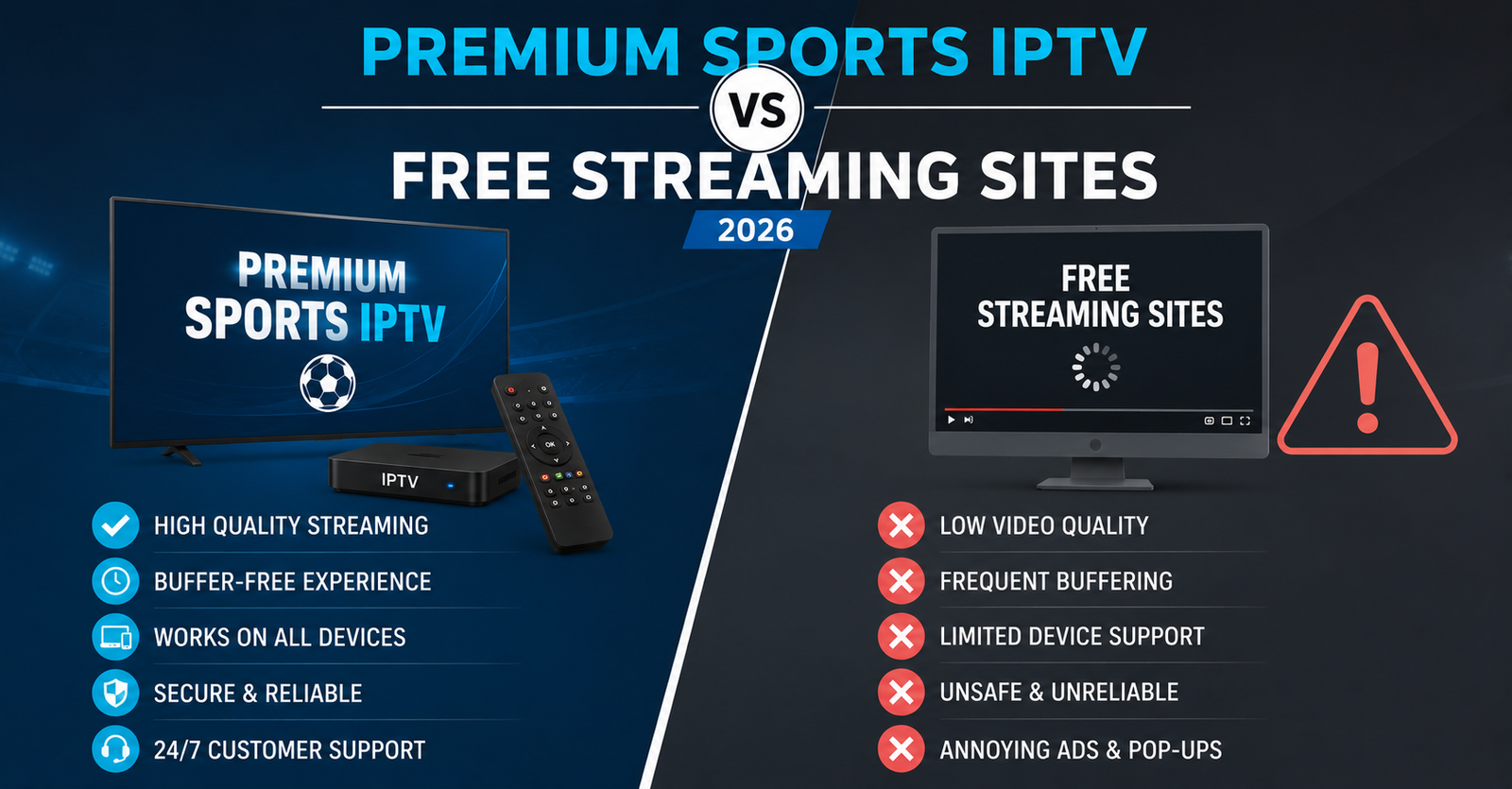
| Free Streaming Sites | Premium Sports IPTV |
|---|---|
| Scraped or mirrored links | Dedicated licensed uplinks |
| No CDN distribution | Multi-region CDN delivery |
| No failover | Automatic failover routing |
| Collapses under peak load | Built for peak traffic spikes |
| No customer support | Support via reseller or operator |
| Unpredictable latency | Consistent low-latency HLS |
| Ad-heavy, often malware-adjacent | Clean delivery environment |
| Zero accountability | Service-level expectations |
The ISP Blocking Picture in 2026 Has Changed
This is something most comparisons skip over entirely, but it is now one of the most important dimensions in the premium sports IPTV vs free streaming sites discussion.
ISPs in the UK, Australia, Germany, and several other English-speaking markets have significantly upgraded their blocking capabilities since 2023. Modern ISP enforcement uses AI-assisted traffic fingerprinting rather than simple domain blacklisting. This means the old cat-and-mouse game of registering a new domain to dodge a block no longer works as reliably as it once did.
For free streaming sites, this has been devastating. Sites that previously stayed accessible by cycling through mirror domains are now being fingerprinted at the traffic pattern level. A domain block and a traffic block are very different things. The latter follows the stream itself.
Properly managed premium sports IPTV handles this through DNS routing, obfuscated delivery paths, and in some cases dedicated IP pools that rotate based on regional enforcement activity. Not every IPTV operator does this well, but the ones worth subscribing to have thought about it. Cheap services have not.
Pro Tip: If you are evaluating a premium sports IPTV provider and they cannot tell you how they handle ISP blocking in your target region, that is a red flag. It means they are either using a single-origin delivery path or they have not invested in the infrastructure that survives enforcement pressure.
One pattern we have noticed repeatedly: free streaming users in heavily blocked markets report progressively worsening access over a sports season as sites get fingerprinted and suppressed. Premium IPTV users on services with active routing management tend not to experience the same degradation.
How IPTV Resellers Fit Into This Picture
Premium sports IPTV reaches most subscribers through an IPTV reseller, not directly from the platform operator. Understanding how this works is useful whether you are a subscriber trying to find a reliable provider or someone considering entering the IPTV business.
An IPTV reseller purchases panel credits from a platform operator and uses those credits to provision subscriptions for customers. The reseller panel is the management layer through which they create accounts, set expiry dates, manage connection limits, and handle customer provisioning. Sub-resellers may sit below them in the distribution chain, purchasing credits from the reseller rather than directly from the operator.
This matters for subscribers because the reseller is your actual point of contact. When there is a service issue, you are dealing with the reseller or sub-reseller, not the platform. A reseller who invests in customer support and monitors their panel for service degradation will resolve issues far faster than one who bought a reseller panel and disappeared.
For people evaluating IPTV reseller opportunities, the premium sports IPTV category is genuinely where the strongest customer retention sits. A subscriber using IPTV specifically for sports has a clear motivation to renew. Churn rates for sports-focused IPTV subscribers are lower than general entertainment subscribers, provided the service actually delivers during matches.
IPTV business owners who anchor their customer base around sports content tend to see higher average subscription values and more predictable renewal cycles. Sports calendars are predictable. Subscribers who want Premier League or NFL coverage know when the season starts and they plan their subscriptions around it.
The Hidden Costs of Free Streaming That Nobody Talks About
Free sports streaming is not free. It is cost-deferred, and the costs land in ways most users do not anticipate.
The advertising ecosystem on free streaming sites is not comparable to display ads on a news site. Many free streaming sites have been documented serving malvertising, which is advertising that delivers malicious code without the user clicking anything. Drive-by downloads, browser hijacking, and credential harvesting scripts have all been documented on popular free streaming aggregators.
Then there is the device performance issue. Free streaming sites built on heavy ad layers consume significant CPU and memory on the host device. On smart TVs and older Android boxes, this creates a streaming experience that is choppy not because of the stream itself but because the device cannot handle the page overhead alongside the video player.
Pro Tip: If you are watching a free stream on a device that is lagging but the stream shows as high quality, the problem is almost certainly the advertising scripts running in the background. Premium sports IPTV delivered through a dedicated app or M3U player eliminates this entirely because you are not browsing a web page.
There is also the legal dimension, which varies by country. In the UK and Australia, copyright enforcement has increasingly targeted consumers rather than just hosting providers. Visiting certain domains has been used as evidence in civil litigation cases. This is still relatively rare but it is a real and growing risk that did not exist in the same form three or four years ago.
What Makes a Premium Sports IPTV Subscription Actually Worth Paying For
Not all paid IPTV is equal, and this matters for the premium sports IPTV vs free streaming comparison because the premium label gets applied very loosely.
There are IPTV services charging five pounds a month with a channel count in the thousands that are barely more reliable than free streaming sites. The channel count means nothing if the delivery infrastructure cannot sustain concurrent viewers during a major event.
The things that actually indicate a premium sports IPTV service worth paying for:
Specific sports event reliability. Ask or test during a major match, not during a quiet Tuesday afternoon. Peak performance is the only performance that matters for sports subscribers.
Connection stability under multi-device load. Many households have two or three people watching simultaneously. A service that handles one stream fine but drops the second connection is not premium regardless of how it markets itself.
Active reseller support. If you are purchasing through an IPTV reseller, how responsive are they? Resellers who understand their panel, monitor their service health, and communicate proactively about maintenance windows are operating a real business. Resellers who went silent after the first payment are a liability.
Channel-specific reliability. Sports coverage requires reliable access to regional broadcast channels, particularly for UK sports subscribers who need consistent access to Sky Sports, TNT Sports, and similar. A service with three hundred sports channels where forty percent buffer is worse than one with sixty channels that all work cleanly.
Providers worth considering for UK-facing sports IPTV include britishseller.co.uk, which serves subscribers and IPTV resellers across the UK market with a focus on sports content reliability.
Why Sports Events Expose the Real Gap Between Services
Major sports events are essentially stress tests for IPTV infrastructure, and they expose weaknesses that normal usage never reveals.
During a Champions League final or a boxing pay-per-view event, premium sports IPTV platforms see simultaneous viewer counts that can be ten to twenty times their average traffic. Every component of the delivery chain comes under load simultaneously. The encoding layer, the CDN edge nodes, the failover routing, the DNS resolution speed, everything gets hit at once.
Infrastructure that was never tested under those conditions fails in unpredictable ways. We have seen resellers on cheap upstream providers experience complete panel blackouts during major events because the platform’s encoding servers could not handle the load spike. The reseller had no warning, no failover alternative, and thousands of angry subscribers.
This is one of the most important questions any IPTV reseller should ask their upstream provider before signing up: what happened during the last major sports event? What was the peak concurrent viewer count? Did anything fail? What was the recovery time?
A platform that cannot answer those questions has not been stress-tested at scale, or the answers are too embarrassing to share.
Pro Tip: As a reseller, never build your entire customer base on a single upstream platform without knowing how that platform performs at peak load. Panel credits mean nothing if the infrastructure behind them fails when your customers need it most.
Frequently Asked Questions
Is premium sports IPTV actually better than free streaming sites in 2026?
Yes, the gap is wider than it has ever been. Free streaming sites have been hit hard by AI-assisted ISP blocking, domain fingerprinting, and infrastructure collapse during peak events. Premium sports IPTV built on proper multi-CDN delivery with failover routing is consistently more reliable, particularly during the major matches where reliability matters most.
Why does premium sports IPTV hold up better during big games?
Because the infrastructure was specifically designed for simultaneous high-volume access. Dedicated uplinks, geo-routing, load balancing across edge nodes, and automatic failover all work together to absorb traffic spikes. Free streaming sites have none of these systems. They rely on third-party links that simply die under load.
Is using free streaming sites actually dangerous?
In two senses, yes. First, the advertising and script environment on most free streaming aggregators is genuinely risky. Malvertising, browser hijacking, and credential theft scripts are well-documented on these platforms. Second, in markets like the UK and Australia, copyright enforcement is increasingly targeting end users, not just hosting providers.
What should I look for when choosing a premium sports IPTV service?
Test it during a major live event, not during quiet hours. Check multi-stream stability. Evaluate the reseller’s support responsiveness. Ask specifically about sports event reliability and how the platform handles ISP blocking in your region. Channel count is irrelevant. Infrastructure reliability is everything.
Is premium sports IPTV worth the monthly cost compared to free options?
If sports streaming is the primary use case, yes. The cost of a quality premium sports IPTV subscription is typically between five and twenty pounds per month depending on the region and connection count. The cost of missing goals due to buffering, or dealing with malware from a free streaming site, is objectively higher.
What questions should an IPTV reseller ask before choosing a platform?
Ask about peak concurrent viewer performance, failover infrastructure, multi-uplink setup, ISP blocking mitigation, and how the platform has performed during specific recent events like major cup finals or boxing nights. Also clarify the reseller panel credit structure and what support the platform provides to resellers directly.
Can ISPs block premium sports IPTV in 2026?
They can attempt to. ISP blocking has become significantly more sophisticated. Premium sports IPTV operators who invest in DNS routing, rotating IP delivery, and obfuscated traffic paths are more resilient against enforcement pressure than free streaming sites, which have no defensive infrastructure at all. Not all premium providers handle this equally well.
Is premium sports IPTV better for families with multiple devices?
Yes, provided the subscription includes adequate simultaneous connections. Most quality premium sports IPTV subscriptions offer two to five connections. Free streaming sites offer none. Every device requires a separate browser tab on a free site, each with its own reliability problem, its own ad exposure, and its own failure risk.
Action Checklists
For Subscribers
Test your chosen premium sports IPTV service during a live match before committing to a long subscription
Confirm how many simultaneous connections are included before purchasing
Ask your IPTV reseller directly how the service performs during Champions League or similar peak events
Check whether your region is affected by ISP blocking and whether the provider has mitigation in place
Run a VPN test if you are in a heavily blocked market to compare delivery with and without routing assistance
Never use a free streaming site on a device that also stores passwords, banking apps, or sensitive data
For IPTV Resellers
Stress-test your upstream platform during a major live event before scaling your customer base
Ask your platform provider for their peak concurrent viewer count and what happened during their last major event
Confirm your reseller panel includes clear connection monitoring so you can identify service issues before customers report them
Build a minimum of two upstream platform relationships so you have a failover option if your primary goes down
Do not market your premium sports IPTV service based on channel count. Market it based on sports event reliability
Communicate proactively with subscribers before major events. It reduces support volume and builds trust
Review your reseller panel credit pricing against your customer acquisition cost every quarter
For Sub-Resellers
Ask your reseller panel owner how the upstream platform handled the last major sporting event
Confirm panel credits do not expire faster than your typical sales cycle
Request trial account access to test stream quality before selling to customers
Build your subscription base around sports-focused customers for better renewal predictability
Never promise reliability you cannot personally verify through your own testing
Conclusion
The premium sports IPTV vs free streaming sites debate was always a bit one-sided for serious viewers. In 2026, it is not even a debate worth having. ISP blocking has matured to the point where free streaming sites are being suppressed at the traffic level, not just the domain level. The infrastructure gap between a properly managed IPTV platform and a scraped link aggregator is enormous, and it becomes most visible at exactly the moment it matters most, when the stadium fills, the referee blows the whistle, and a hundred thousand concurrent viewers hit the same source simultaneously.
For subscribers, the choice is straightforward. For IPTV Panel resellers and sub-resellers building businesses around sports content, the infrastructure decision is not a secondary concern. It is the business.
The single most important lesson from years of watching this space is that sports IPTV customers are not loyal to platforms. They are loyal to matches that work. Deliver consistency across an entire football season and your renewal rates will reflect it. Let people miss a goal during the title run-in and your churn figures will tell that story for months.