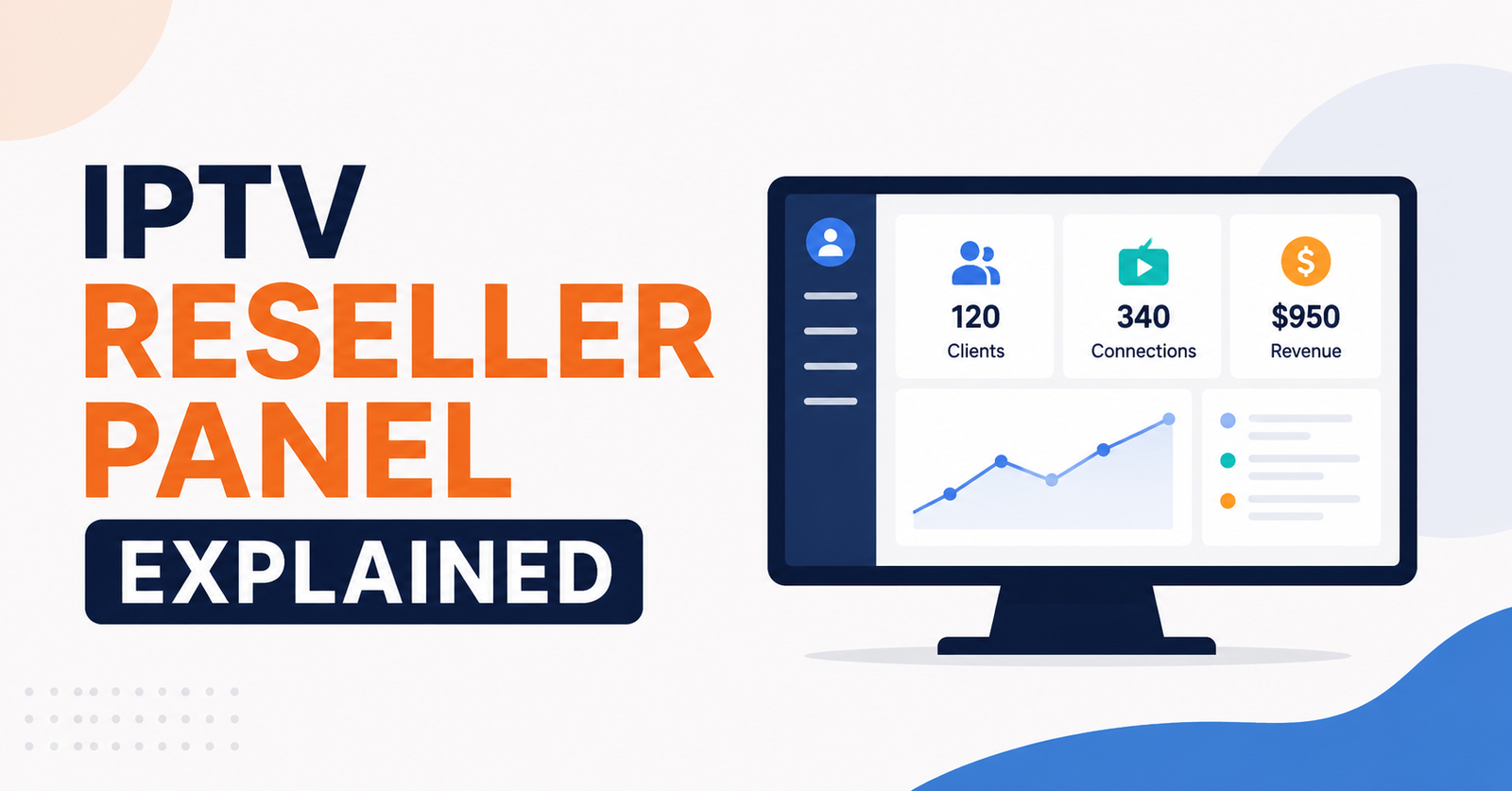

IPTV Reseller Panel Explained: What Nobody Tells You Before You Buy Credits
A guy messaged me last year, furious. He had spent his savings on 500 panel credits from a “wholesale” supplier, sold subscriptions to forty customers in his neighbourhood, and then the panel went dark for three days during a Champions League week. His customers wanted refunds. His supplier stopped replying. He thought he had bought a business. What he had actually bought was access to someone else’s server with no guarantees attached.
So let me give you the IPTV Reseller Panel Explained answer up front, because most articles bury it. A UK IPTV reseller panel is a control dashboard that lets you create, manage, and renew customer subscriptions using prepaid credits, while the actual streaming infrastructure sits with the panel owner above you. You are renting distribution rights, not owning the network. The most important takeaway: your business is only as stable as the infrastructure you cannot see. Choose the operator above you carefully, because their failover, their uplinks, and their honesty become yours.
That single misunderstanding causes more reseller failures than ISP blocking ever will.
What a Reseller Panel Actually Is Under the Hood
Strip away the marketing and a reseller panel is three things bolted together. There is a credit system that tracks your prepaid balance. There is a subscription manager that generates lines, M3U links, and login details for your customers. And there is a layer of access to streaming sources that someone else maintains.
When you create a subscription, you spend panel credits. One credit usually equals one month of one connection, though pricing tiers vary by volume. The panel does not magically produce streams. It points your customer’s app at servers controlled higher up the chain.
This is the part new resellers miss. You are a middle layer. Above you sits a panel owner or a master IPTV operator who controls the real hardware. Below you may sit a sub-reseller you have given limited credits to. You are buying a seat in a distribution network, and your job is sales, support, and trust, not engineering.
Pro Tip:
Before buying credits, ask the panel owner one blunt question: “Who controls the source servers, you or someone above you?” If they dodge it, you are at least three layers deep in a chain, and every layer adds a point of failure you cannot fix.
The Credit Economy That Decides Whether You Profit
Credits are where the money math lives, and where most new resellers price themselves into a corner.
A credit reseller buys in bulk to lower the per credit cost, then sells subscriptions at retail. The gap between what you pay per credit and what your customer pays is your margin. Simple in theory. Brutal in practice, because customers compare prices constantly and a race to the bottom is always tempting.
| Buying Pattern | What Actually Happens |
|---|---|
| Tiny credit packs | Highest cost per line, no margin room |
| Mid volume packs | Workable margin, manageable risk |
| Large upfront packs | Best price, but cash tied to one supplier |
| Buying from a sub seller of a sub seller | Cheapest entry, worst stability |
Here is a field lesson. One reseller I spoke with chased the lowest credit price he could find, bought from a panel that was itself three hops down the chain, and saved maybe twelve cents a line. When the top of that chain had a billing dispute, the entire branch went offline and his cheap credits became worthless overnight. Margin means nothing if the lines stop working.
Why Most Resellers Underprice and Regret It
New panel owners assume cheap pricing wins customers. It wins the wrong customers.
The cheapest subscribers churn the fastest, complain the most, and demand the heaviest support. After reviewing hundreds of support requests across reseller operations, a clear pattern shows up: the customers paying rock bottom prices generate the majority of tickets. They expect flawless service for the price of a coffee, and they leave the moment a competitor undercuts you by a dollar.
Pro Tip:
Price slightly above the desperate floor and sell reliability instead. A IPTV reseller who charges a fair rate and answers messages within an hour keeps customers far longer than one who is cheapest but invisible when buffering starts.
Sub Resellers: The Growth Lever Nobody Manages Properly
Once your customer base grows, you will be tempted to recruit a sub-reseller and hand them a slice of your panel credits. This is how a small IPTV business owner becomes a small IPTV distribution network. It is also how trust gets diluted.
A sub-reseller operates under your account, draws from your credit pool, and serves their own customers. You earn from their consumption without doing their sales work. The catch is accountability. If your sub-reseller oversells, vanishes, or mistreats customers, the damage rolls uphill to your reputation and your balance.
Treat sub-reseller onboarding like hiring. Set credit limits. Watch their consumption weekly. A common mistake we repeatedly see is a panel owner giving an unknown sub-reseller a huge credit allocation on day one, then discovering those credits funded a scam that burned the customers and left the panel owner holding the complaints.
What Happens When the Infrastructure Above You Fails
You do not control the servers, so you need to understand how they fail.
The streaming sits on source servers that push video through HLS delivery to apps. When ISPs interfere, they often use DNS poisoning to redirect or block the domains those apps rely on, or DPI throttling that slows the stream until it stutters. A serious panel owner runs multiple uplinks, backup DNS routing, and automatic failover so that when one path is blocked, traffic shifts to another. A weak one runs a single source with no redundancy.
| Fragile Setup | Resilient Setup |
|---|---|
| One streaming source | Several independent sources |
| No failover | Automatic failover between uplinks |
| Single DNS path | Backup DNS routing |
| No monitoring | Active monitoring and alerts |
| Silent during outages | Status updates to resellers |
During a major sports event, this difference becomes obvious within minutes. Traffic spikes, ISPs watch for unusual load, and fragile panels collapse exactly when your customers care most. We noticed unusual ISP behaviour clustering around big match nights, the kind of targeted slowdown that only hits during predictable demand peaks.
Reading Churn Through Your Support Tickets
Your support inbox is the most honest analytics tool you own.
When buffering complaints cluster at the same hour every evening, that is congestion upstream, not customer error. When complaints spike only during marquee events, your panel owner lacks event capacity. When the same handful of customers message constantly, they were mispriced and will churn regardless. Reading these patterns tells a reseller more about infrastructure health than any sales dashboard.
Pro Tip:
Keep a simple log of complaint timestamps. Three weeks of timestamps will reveal whether your problems are upstream capacity, regional ISP blocking, or just one unhappy customer, and that tells you whether to switch panel owners or just manage expectations.
Choosing a Panel: The Questions That Filter Out Amateurs
Most resellers evaluate panels on price and channel count. Those are the least predictive signals.
What actually matters is the operator behind it. Ask how they handle failover. Ask whether they own their source or resell it. Ask how they communicate during outages, because silence during a blackout costs you customers directly. A reliable IPTV reseller panel is downstream of a serious operator who treats reliability as the product. For resellers comparing options, a provider like britishseller.co.uk illustrates the kind of structured reseller setup worth measuring others against, particularly around clear credit terms and support responsiveness.
Step by Step: How a Subscription Moves Through the Chain
- You buy panel credits from your panel owner.
- A customer pays you for a month of service.
- You spend one credit in the panel to generate their line and login.
- Their app connects to source servers through HLS delivery.
- When you renew, you spend another credit and the cycle repeats.
Every link in that chain can break. Your job as a reseller is to control the parts you can, sales, support, pricing, and to choose an operator who controls the rest competently.
FAQ
What is an IPTV reseller panel explained in simple terms?
An IPTV reseller panel explained simply is a dashboard where you use prepaid credits to create and renew customer subscriptions, while the actual streaming servers are run by an operator above you. You handle sales and support. They handle infrastructure. You are renting distribution access, not owning the network itself.
How does an IPTV reseller panel explained differ from being a customer?
A customer buys one subscription to watch. A reseller buys panel credits in bulk and resells many subscriptions for profit. The IPTV reseller panel explained here gives you tools to manage lines, sub-resellers, and renewals, turning you from a single viewer into a small distribution operation.
How many panel credits should a new reseller start with?
Start with a mid sized pack, not the largest. Enough to learn the panel and serve early customers without tying all your cash to one supplier you have not tested. Once you confirm the operator’s stability through a real busy period, scale your credit purchases upward gradually.
Why does my panel buffer only during big sports events?
That is an upstream capacity problem, not your fault. Weak panels lack event ready redundancy, so traffic spikes overwhelm their source servers. Resilient operators run multiple uplinks and failover that absorb the surge. If it happens repeatedly, your panel owner cannot handle peak load and you should consider switching.
Can a sub-reseller damage my IPTV business?
Yes. A sub-reseller draws from your credit pool and serves customers under your account. If they oversell or disappear, the complaints and losses roll back to you. Set strict credit limits, monitor their consumption weekly, and treat onboarding a sub-reseller with the same caution you would apply to a hire.
Is the cheapest IPTV reseller panel the best value?
Rarely. The cheapest panels usually sit several hops down a distribution chain, adding failure points you cannot control. A slightly more expensive panel owner with real failover and honest outage communication keeps your customers online and loyal, which protects your margin far better than a few cents saved per line.
Execution Checklists
For subscribers:
- Confirm the seller answers messages before you pay
- Ask whether they offer a short trial line
- Note any buffering times and report them with timestamps
- Avoid the absolute cheapest seller, they vanish fastest
For resellers:
- Ask the panel owner who controls the source servers
- Buy a mid sized credit pack first and test through a busy week
- Log every support complaint with its timestamp
- Price above the desperate floor and sell responsiveness
- Confirm the operator communicates during outages
For sub-resellers:
- Negotiate clear credit limits in writing
- Verify the panel owner above you owns real infrastructure
- Keep your own customer records separate from the panel
- Watch your credit balance weekly for unexpected drains
Conclusion
With the IPTV reseller panel explained properly, the picture is clearer than the marketing suggests. A panel is a credit powered dashboard that lets you sell and manage subscriptions, but the stability of your IPTV business lives in infrastructure you do not own. The successful reseller is not the one with the cheapest panel credits. It is the one who chose a serious panel owner, priced for reliability, managed sub-resellers carefully, and read their support tickets like a diagnostic tool.
The single lesson worth remembering: in this chain, you are buying trust as much as technology. Pick the operator above you with the same care you would pick a business partner, because for all practical purposes, they are one.