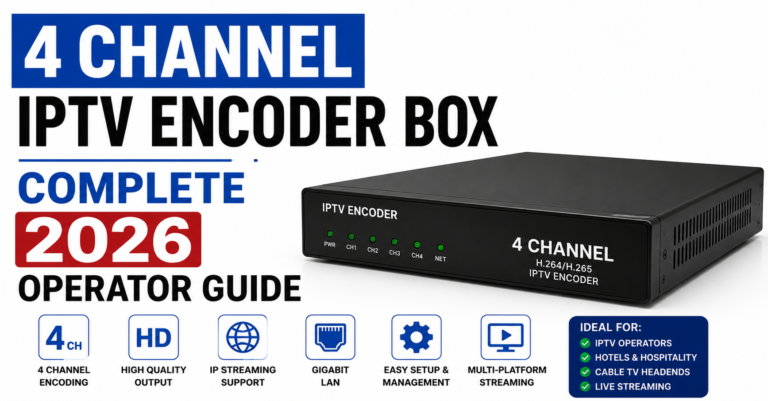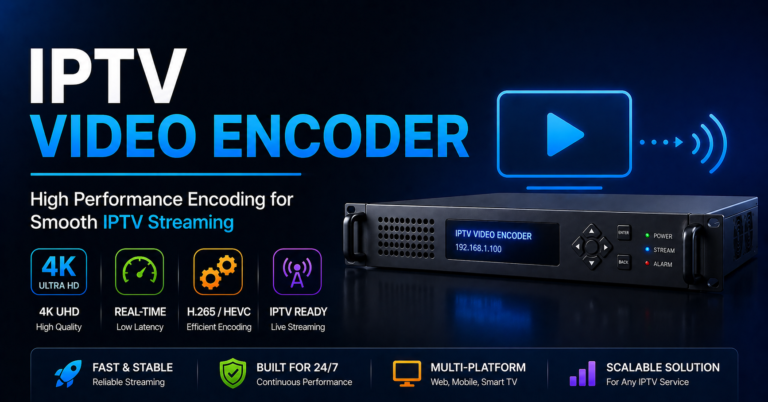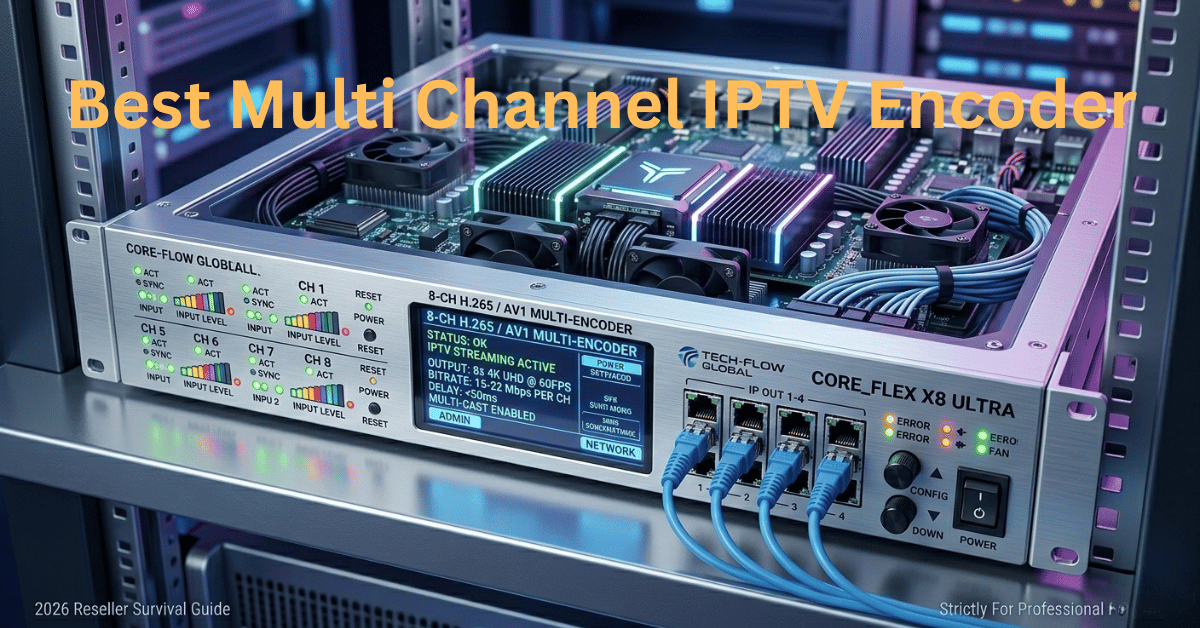

Imagine this: 340 guests. A Premier League final streaming live. Your hotel’s IPTV system buckles under simultaneous room requests, and within six minutes, the front desk phone hasn’t stopped ringing. That’s not a hypothetical — that’s what happens when a property manager sources the cheapest encoder they could find on a B2B marketplace and assumes it’ll hold under real load. It won’t. Choosing the best multi channel IPTV encoder for hotel environments isn’t about ticking a spec sheet.
It’s about engineering for the moment nobody wants to explain to a full house of guests who’ve just missed a penalty shootout.
What Makes the Best Multi Channel IPTV Encoder for Hotel Use Actually Different
Most procurement teams make the same mistake: they compare encoder specs the way they’d compare televisions — by screen resolution and price bracket. But a hotel IPTV Reseller Panel encoder isn’t consumer electronics. It’s broadcast infrastructure running continuously, often with zero tolerance for reboot cycles during peak occupancy. The best multi channel IPTV encoder for hotel deployment needs to handle simultaneous encoding of 16, 32, or even 64 channels — all while maintaining sub-200ms latency per stream, stable bitrate output, and HDMI or SDI input flexibility depending on your source equipment.
The difference between a £400 unit and a £2,000 unit isn’t just build quality — it’s the difference between adaptive bitrate support and fixed encoding, between a unit that throttles at 80% load and one that holds clean at 95%. Hotels with conference facilities, sports bars, or executive lounges absolutely cannot afford that compromise.
Pro Tip: Always spec your encoder for 30% more channels than your current room count. Properties expand. Contracts don’t renegotiate themselves mid-season.
H.265 vs H.264 — Why Codec Choice Defines Your Hotel IPTV Infrastructure
When evaluating the best multi channel IPTV encoder for hotel networks, the codec conversation is unavoidable — and it’s where most installs go wrong quietly. H.264 remains dominant in legacy deployments, but H.265 (HEVC) delivers the same visual quality at roughly half the bitrate. In a 200-room property running 4K content across multiple zones, that difference translates directly to bandwidth savings and reduced strain on your internal switching infrastructure.
The practical issue is compatibility. Older smart TVs — particularly those installed pre-2019 — may not decode H.265 natively, which means you’re either transcoding on the fly or delivering degraded streams to a portion of your estate. The smartest approach is a dual-profile encoder: one that can output both H.264 and H.265 simultaneously, routing each to compatible endpoints without manual intervention.
Bitrate efficiency formula (WordPress compatible):
Bandwidth Saving (%) = ((B_264 − B_265) / B_264) × 100
Where B_264 = H.264 bitrate per channel, B_265 = H.265 bitrate per channel. At 8 Mbps vs 4 Mbps per 1080p channel across 32 channels, you’re reclaiming 128 Mbps of sustained headroom — enough to meaningfully reduce your uplink requirements.
Channel Density: How Many Streams Can Your Encoder Actually Handle?
This is where manufacturers get creative with their marketing. A unit advertised as “64-channel capable” may achieve that only at reduced resolution — 720p rather than 1080p full HD — or with compromised frame rates under thermal load. When sourcing the best multi channel IPTV encoder for hotel projects, you need to push vendors on their sustained encoding benchmarks, not peak lab figures.
Real-world channel density for hotel use typically breaks down like this:
- Budget tier (8–16 channels): Suitable for small boutique hotels, B&Bs, or serviced apartments with a single satellite or cable input source
- Mid-range (16–32 channels): Covers most three and four-star properties with a standard channel lineup plus premium sports tiers
- Enterprise tier (32–64+ channels): Required for large hotel groups, conference centres, or mixed-use hospitality venues with multiple input sources
Thermal management matters more than most buyers realise. Fanless units that run cool in a lab will throttle in a sealed comms rack during summer. Always verify operating temperature ranges against your actual server room conditions.
IP Output Standards — RTSP, HLS, and MPEG-TS Explained for Hotel Deployments
| Feature | Budget Encoder | Premium Encoder |
|---|---|---|
| Output Protocol | RTSP only | RTSP + HLS + MPEG-TS |
| Simultaneous Channels | 8–16 at 1080p | 32–64 at 1080p |
| Adaptive Bitrate | ❌ | ✅ |
| Redundant Power Supply | ❌ | ✅ |
| Remote Management | Basic web UI | Full API + SNMP |
| HDCP Compliance | Partial | Full |
| Warranty (UK) | 12 months | 36 months |
The best multi channel IPTV encoder for hotel use will support all three output protocols simultaneously. HLS is essential if any content is being pushed to guest mobile devices or smart TVs via middleware. MPEG-TS over UDP remains the backbone of headend-to-set-top-box delivery in traditional hotel IPTV architectures. RTSP serves monitoring and secondary display applications. A unit that forces you to choose one protocol is a unit that forces architectural compromises later.
Pro Tip: Insist on IGMP snooping compatibility in your encoder’s multicast output. Without it, your network switches will flood every port with stream data — a silent killer of hotel LAN performance that only shows up under full occupancy.
Why UK Hotel IPTV Installers Are Moving Away From Single-Vendor Headend Solutions
There’s a structural shift happening in UK hotel IPTV procurement right now. Large single-vendor headend packages — where one supplier provides encoder, middleware, STBs, and support under a single contract — are losing favour among mid-market properties. The reason isn’t cost, necessarily. It’s lock-in. When that vendor discontinues a firmware line or gets acquired, your entire system becomes a legacy liability overnight.
Operators who’ve been around long enough to watch two or three of those cycles tend to build modular systems: best-in-class encoder from one manufacturer, open middleware from another, network infrastructure sourced independently. This approach demands more integration knowledge upfront but delivers far greater resilience and upgrade flexibility over a seven-to-ten-year asset lifecycle.
For the encoder layer specifically, this means prioritising units with open API access, ONVIF compatibility, and vendor-neutral firmware update policies. The best multi channel IPTV encoder for hotel environments in 2026 is one that talks to everything — not just its own ecosystem.
BritishTV Solutions.com — Infrastructure Built for Resellers Who Supply Hotel-Grade IPTV
If you’re sourcing the best multi channel IPTV encoder for hotel contracts or building out reseller packages for hospitality clients, infrastructure quality at the distribution layer is just as critical as the hardware at the headend. BritishTVSolutions.com operates UK-based 10Gbps+ uplink servers engineered specifically for high-density, multi-channel IPTV delivery — the kind of backbone that supports hotel reseller networks without the buffering, packet loss, or peak-time degradation that cheaper providers quietly accept as normal.
This isn’t a consumer IPTV service. It’s infrastructure designed for operators who understand that a single hotel contract means hundreds of simultaneous streams, and that failure during a major sports broadcast isn’t just a customer service issue — it’s a contract termination event.
Read More: IPTV Reseller Panels
The Reseller Success Checklist: Hotel IPTV Encoder Deployments Done Right
- Spec for headroom, not current demand — Always size your encoder for at least 30% more channels than the property currently requires
- Validate codec compatibility across the entire TV estate before committing to H.265-only output
- Test sustained load at 95% channel capacity for a minimum of 72 hours before sign-off — peak performance means nothing if thermal throttling kicks in during a sold-out weekend
- Confirm multicast and IGMP snooping support at both the encoder and network switch level to prevent LAN saturation
- Pair hardware with a reliable upstream distribution partner — the best multi channel IPTV encoder for hotel use is only as good as the signal chain feeding it; BritishTVSolutions.com provides the uplink infrastructure that makes the entire stack perform under real-world pressure