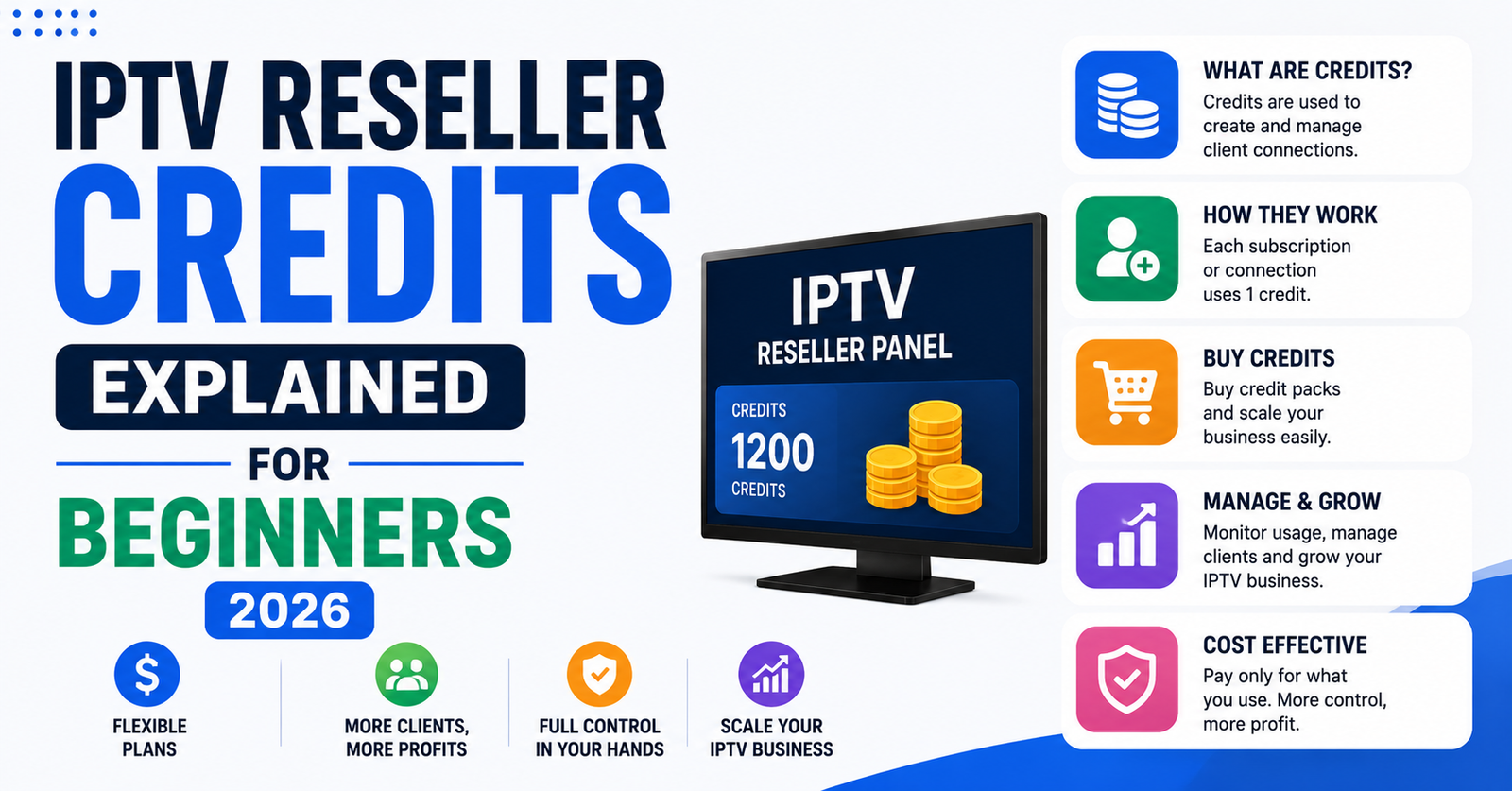

IPTV Reseller Credits Explained: What Nobody Tells You Before You Buy Your First Panel
There’s a moment every new reseller hits — usually around week two — where the numbers stop making sense. You bought 500 credits. You’ve activated maybe 40 subscriptions. Your panel says you’ve got 60 credits left. And you’re sitting there wondering where 400 credits actually went. That confusion? It’s not stupidity. It’s the system working exactly as designed, and nobody bothered to walk you through it. IPTV reseller credits explained properly would have saved you that panic. This article does what your provider’s Telegram group never will.
Credits are the invisible fuel line of every reseller operation. They determine how many subscriptions you can generate, what duration options you can offer, and ultimately, whether your business runs at a profit or bleeds out slowly through miscalculation. If you’ve been treating credits like a simple top-up balance, you’ve already been leaving money on the table. This is IPTV reseller credits explained from the perspective of someone who’s burned through panels, lost margins to poor planning, and rebuilt the math from scratch.
How IPTV Reseller Credits Actually Function Inside Your Panel
Strip away the marketing language and here’s the mechanical truth: your panel is a vending machine. Credits are the coins. Each subscription type — one month, three months, six months, annual — has a fixed credit cost set by your provider. You don’t negotiate that cost per subscription. You negotiate it per credit, at the point of purchase.
That distinction matters enormously. When a provider says “credits start at £0.08 each,” they’re quoting bulk pricing that only applies at certain volume tiers. Buy 100 credits and you might pay £0.15 each. Buy 5,000 and it drops. The subscription cost in credits stays identical either way. IPTV reseller credits explained at this level reveals the first real lever: your profit margin lives in the gap between your per-credit cost and your retail subscription price.
Pro Tip: Before committing to any provider, request their full credit cost matrix — every subscription duration mapped against the credit cost. Then calculate your actual margin per package at your expected purchase volume. Most resellers skip this and discover their one-month packages are loss leaders only after they’ve sold fifty of them.
The Credit-to-Subscription Ratio That Decides Your Margin
Not all credit structures are equal, and this is where IPTV reseller credits explained gets commercially dangerous. Provider A might charge 1 credit for a one-month subscription. Provider B charges 10 credits for the same thing. The actual cost in currency could be identical — Provider A sells credits at £1.50 each while Provider B sells them at £0.15 each. Same effective price, wildly different panel math.
Why does this matter? Because resellers who manage multiple panels often confuse credit quantities with value. A dashboard showing 2,000 remaining credits feels comfortable. But if each activation costs 20 credits, you’ve only got 100 subscriptions left. That “comfortable” balance is four days of stock for an active reseller.
- Always convert credit balances into subscription counts, not currency
- Track your average credit consumption per week, not per month
- Set reorder alerts at 30% remaining subscription capacity, not 30% remaining credits
- Compare providers using cost-per-subscription, never cost-per-credit in isolation
Why Bulk Credit Pricing Creates a Cash Flow Trap
Here’s an angle most guides on IPTV reseller credits explained completely ignore: bulk buying is a cash flow weapon that cuts both ways. Yes, buying 10,000 credits at once drops your per-credit cost significantly. But you’ve just locked capital into a single provider’s ecosystem with zero liquidity.
If that provider’s servers degrade, if their channel list shrinks, if their uplink gets flagged — your credits don’t transfer. They don’t refund. They sit in a panel you can no longer confidently sell from, and your customers are already messaging you about buffering during the football.
The smarter approach is staged purchasing. Buy enough credits to cover two weeks of projected activations, plus a 20% buffer for trial extensions and replacements. Reassess the provider’s stream quality every cycle before reloading. This protects your cash position and keeps you agile.
Pro Tip: Treat credit purchases like inventory management in retail. Overstocking ties up working capital. Understocking loses sales. The sweet spot is a rolling two-week supply with weekly quality audits on your provider’s streams before each reload.
IPTV Reseller Credits Explained Through Real Margin Calculations
Let’s get concrete. Suppose your provider charges £0.10 per credit and a one-month subscription costs 15 credits. Your cost per one-month activation is £1.50. You sell that subscription at £7.99. Gross margin: £6.49 per customer per month.
Now look at the twelve-month package. Say it costs 90 credits — that’s £9.00 to you. You sell it for £44.99. Gross margin: £35.99 per customer, but spread across twelve months, your effective monthly margin drops to £3.00 compared to £6.49 on the monthly plan.
| Package Duration | Credit Cost | Your Cost | Retail Price | Gross Margin | Monthly Effective Margin |
|---|---|---|---|---|---|
| 1 Month | 15 credits | £1.50 | £7.99 | £6.49 | £6.49 |
| 3 Months | 35 credits | £3.50 | £19.99 | £16.49 | £5.50 |
| 6 Months | 55 credits | £5.50 | £29.99 | £24.49 | £4.08 |
| 12 Months | 90 credits | £9.00 | £44.99 | £35.99 | £3.00 |
IPTV reseller credits explained through this table reveals the tension every reseller faces: annual packages reduce churn but compress monthly margins. Monthly packages maximize margin but increase support load and cancellation risk. Your ideal mix depends on your operational capacity.
Credit Expiry Policies Nobody Reads Until It’s Too Late
Here’s a dimension of IPTV reseller credits explained that causes genuine financial damage: expiry windows. Some providers attach a validity period to purchased credits. Buy 1,000 credits in January, and any unused credits might expire by April. You won’t see a warning. The credits simply vanish from your dashboard.
This isn’t universal, but it’s common enough that you need to check before buying. Ask your provider three questions before any bulk purchase:
- Do purchased credits have an expiration date?
- Is expiry calculated from purchase date or from last panel login?
- Can expired credits be reinstated if I top up within a grace period?
Providers who expire credits are essentially forcing purchase velocity. They want you buying and activating constantly. For a high-volume reseller, this isn’t an issue. For someone scaling slowly or testing a new market, it’s a hidden tax on your capital.
Pro Tip: If your provider enforces credit expiry, calculate your minimum weekly activation rate needed to consume credits before they lapse. If that rate exceeds your current customer acquisition pace, buy smaller batches — even at higher per-credit cost. Paying more per credit beats losing credits entirely.
How Sub-Reseller Credit Distribution Changes the Game
Once you move beyond selling directly to end users, IPTV reseller credits explained takes on a layered complexity. As a master reseller, you purchase credits from a provider. You then allocate a portion of those credits to your sub-resellers, who use them to activate their own customers. Each tier takes a margin cut.
The challenge is pricing your sub-reseller credits correctly. Set the per-credit price too high, and your sub-resellers can’t compete with other panels. Set it too low, and you’re subsidizing their business while starving your own margin. The calculation needs to account for their expected retail pricing, the competitive landscape in their target market, and the volume they’re likely to push.
Most master resellers use tiered pricing — different per-credit rates based on purchase volume. A sub-reseller buying 100 credits pays more per credit than one buying 2,000. This rewards your most productive partners and self-selects for serious operators.
- Define a minimum of three volume tiers for sub-reseller credit pricing
- Build at least 25% margin into your lowest tier price
- Offer a small bonus credit allocation (5–10%) for sub-resellers who reorder within seven days
- Never allow sub-resellers to hold more than 30 days of projected stock — it reduces their switching cost to zero
Panel Credit Allocation and the Xtream Codes API Connection
Understanding IPTV reseller credits explained at the technical layer means understanding how credits interact with your panel’s API. In most Xtream Codes-based panels, credit deduction is triggered the moment a subscription line is created. The API call generates the M3U URL or Xtream Codes login credentials, deducts the credit cost, and logs the activation.
This happens instantly and irreversibly. There’s no “undo” button if you create a test line and forget to use a trial credit type. There’s no reversal if a customer pays via PayPal, you activate the line, and they file a chargeback three days later. The credit is spent.
That irreversibility is why experienced resellers build a small credit buffer into their pricing — typically 3–5% of monthly credit spend — to absorb test lines, customer disputes, and occasional duplicate activations. Think of it as operational shrinkage, identical to what any physical retailer accounts for.
Pro Tip: Configure your panel’s API to require confirmation before line creation if your panel software supports it. A two-step activation flow — create draft, then confirm — prevents accidental credit burns from misclicks or automated scripts misfiring.
ISP Blocking, Server Downtime, and the Hidden Credit Drain
Nobody discusses this under IPTV reseller credits explained, but server-side disruptions have a direct credit cost. When your provider’s uplink server gets blocked by an ISP using deep packet inspection or DNS poisoning techniques, your customers experience buffering or total blackouts. They contact you demanding fixes. Some demand refunds. Others demand subscription extensions.
Every extension you issue burns additional credits. A three-day extension on a monthly subscription might cost a fractional credit or, depending on your panel, a full credit cycle. When a major sporting event triggers an ISP enforcement sweep and half your customer base reports outages, those extension credits add up fast.
This is where backup uplink servers become a margin protection tool, not just a technical feature. Providers who maintain geographically distributed server clusters with automatic failover reduce your exposure to mass outage events. Fewer outages mean fewer extension requests, which means fewer credits burned on retention.
- Ask your provider how many uplink servers they operate and in which regions
- Test failover response time by monitoring streams during known high-traffic events
- Track your monthly credit spend on extensions separately from new activations
- If extension credits exceed 8% of total credit spend, your provider has a reliability problem
Credit-Based Pricing Strategies That Reduce Customer Churn
IPTV reseller credits explained from a retention angle opens up a different playbook entirely. Most resellers price linearly — one month is X, three months is 3X minus a discount. But credit economics allow for more creative structures that lock customers into longer cycles without aggressive discounting.
One approach is the loyalty reload model. Offer customers who renew within 48 hours of expiry a small bonus — an extra week added to their next subscription. This costs you a fraction of a credit in most panel systems but dramatically increases on-time renewals. Customers feel rewarded. You maintain predictable credit consumption cycles.
Another tactic is the bundled household package. Instead of selling three separate one-month connections to a family (costing you 45 credits using our earlier example), create a household bundle at 40 credits internally and price it at £19.99. The customer saves compared to buying three individual subscriptions. You save five credits per cycle and reduce your support tickets by two-thirds because one household contact manages all three lines.
Pro Tip: Build your pricing tiers around credit efficiency, not just customer psychology. The cheapest package for the customer should also be the most credit-efficient package for you. When those two things align, your business scales without margin compression.
Tracking Credit Spend: The Dashboard Metrics That Matter
If IPTV reseller credits explained stopped at “buy credits, sell subscriptions,” every reseller would be profitable. They’re not. The gap between surviving and scaling lives in tracking. Your panel dashboard shows a credit balance. That’s the least useful number on the screen.
What you need to track weekly:
- Credits consumed per new activation versus credits consumed per renewal
- Average credit cost per customer acquired (factor in trials and failed conversions)
- Credit burn rate from extensions and replacements
- Sub-reseller credit velocity (how fast each sub-reseller consumes allocated credits)
- Days of remaining stock at current activation pace
| Metric | Healthy Range | Warning Zone | Critical |
|---|---|---|---|
| Extension credit burn | Below 5% | 5–10% | Above 10% |
| Sub-reseller reorder frequency | Every 5–10 days | Every 15–20 days | Over 30 days |
| Trial-to-paid conversion rate | Above 40% | 20–40% | Below 20% |
| Credit stock runway | 14+ days | 7–14 days | Below 7 days |
These numbers tell you more about your business health than any revenue figure. A reseller burning 15% of credits on extensions is subsidizing their provider’s poor infrastructure with their own margin.
IPTV Reseller Credits Explained for Multi-Panel Operations
Advanced resellers often run credits across two or three panels simultaneously. This isn’t about disloyalty to a provider — it’s about risk distribution and channel diversity. Different panels carry different channel packages, different server infrastructures, and different geographic strengths. A panel that delivers flawless streams in the UK might buffer badly for European customers.
Managing credits across multiple panels requires a unified tracking system outside of any single dashboard. A simple spreadsheet works for two panels. Beyond that, you need a structured inventory log that tracks credit purchases, per-panel activation rates, and margin per subscription per panel.
The trap with multi-panel operations is credit fragmentation. You spread your purchasing power across three providers, lose volume discount tiers on each one, and end up paying more per credit across the board than you would concentrating on a single panel. The offset needs to come from reduced churn, better geographic coverage, or access to exclusive channel packages that justify the higher per-credit cost.
When to Walk Away From a Credit-Based Provider
Not every IPTV reseller credits explained guide will tell you this: sometimes the right move is to stop buying credits entirely and switch providers. The signals are clear if you know where to look.
If your provider has increased credit costs twice in six months without improving infrastructure, that’s margin erosion dressed up as inflation. If their server uptime has dropped below 97% during peak hours, your extension credit burn is eating your profit. If they’ve lost major channel categories and haven’t replaced them within two weeks, your customers are already searching for alternatives — and so should you.
The switching cost is real. You’ll lose unused credits. You’ll need to migrate active subscribers, which means issuing new connection details to every customer. You’ll spend a weekend reconfiguring your storefront. But staying with a deteriorating provider costs more in slow customer bleed than switching costs in one painful weekend.
Pro Tip: Before switching, activate a test subscription on two or three alternative panels and monitor stream quality for a full week, including at least one major sporting event window. Never migrate your customer base based on a five-minute demo stream — that’s how you switch from one problem to another.
Frequently Asked Questions
How are IPTV reseller credits different from a simple account balance?
Credits are a fixed-unit currency within your panel, not a monetary balance. Each subscription type consumes a set number of credits regardless of how much you paid per credit. Your profit comes from the gap between your bulk credit cost and your retail subscription price. Unlike a cash balance, credits cannot typically be withdrawn, transferred between providers, or converted back to currency once purchased.
Can I transfer unused IPTV reseller credits to a different panel?
No. Credits are locked to the provider’s panel where they were purchased. There is no cross-platform credit standard in the IPTV reseller industry. If you switch providers, unused credits on the old panel are a sunk cost. This is why staged purchasing — buying two weeks of stock at a time — protects you against provider quality drops without overcommitting capital.
What happens to my credits if my IPTV provider shuts down?
You lose them entirely. Provider shutdowns, whether from enforcement action, financial failure, or infrastructure collapse, void all purchased credits instantly. No legitimate provider offers credit insurance or refund guarantees against shutdown. Your only protection is diversifying across multiple panels and never holding more than 30 days of credit stock on any single provider.
Why do some IPTV reseller credits explained guides recommend annual packages when the margin is lower?
Annual packages trade per-month margin for cash flow predictability and reduced churn. A customer locked into a twelve-month subscription won’t shop around for nearly a year, reducing your acquisition cost for that slot to zero for eleven months. The lower monthly effective margin is offset by elimination of monthly renewal risk, reduced support contacts, and guaranteed credit consumption planning.
Is it possible to set different credit prices for different sub-resellers?
Yes, most Xtream Codes-based panels support tiered sub-reseller pricing. You can assign custom credit rates per sub-reseller account based on their purchase volume or agreement terms. This allows you to reward high-volume partners with lower per-credit costs while maintaining healthy margins on smaller sub-resellers who purchase less frequently.
How do I calculate the right retail price based on my IPTV reseller credit cost?
Multiply your per-credit cost by the credit requirement for each subscription duration to find your activation cost. Then apply a minimum 300% markup for one-month packages and 250% for longer durations. Factor in an additional 5% credit buffer for extensions, test lines, and chargebacks. Your final retail price must cover activation cost, buffer, payment processing fees, and your target net margin.
Can ISP blocking events affect my IPTV reseller credit balance?
Indirectly, yes. ISP blocking via deep packet inspection or DNS poisoning causes stream outages for your subscribers. Affected customers request extensions or replacement lines, both of which consume additional credits from your balance. During major enforcement sweeps, extension credit burn can spike to 15–20% of your total monthly credit spend if your provider lacks backup uplink servers with automatic failover capability.
What is HLS latency and how does it relate to IPTV reseller credit value?
HLS latency refers to the delay in HTTP Live Streaming delivery, typically ranging from 10–30 seconds behind live broadcast. High HLS latency increases customer complaints, especially during live sports, leading to more refund requests and subscription extensions that consume your credits. Providers who invest in low-latency infrastructure (sub-10-second delay) generate fewer support tickets per subscriber, making each credit you spend on activation more valuable over its subscription lifetime.
IPTV Reseller Credits Explained: Your Execution Checklist
- Request the full credit-to-subscription cost matrix from your provider before purchasing any credits
- Calculate your true per-subscription cost at your realistic buying volume — not the volume you hope to reach
- Set a maximum credit stock limit of 14 days’ projected activations on any single panel
- Separate your tracking for new activation credits versus extension and replacement credits
- Build a 5% credit buffer into every retail price to absorb chargebacks, test lines, and extensions
- Audit your provider’s stream quality weekly — test during peak evening and live sports windows before reloading credits
- If running sub-resellers, implement at least three volume-based pricing tiers with 25% minimum margin at the lowest tier
- Track sub-reseller credit velocity weekly and flag any partner who hasn’t reordered in 20+ days
- Maintain active test accounts on at least two alternative panels so you can migrate within 48 hours if your primary provider degrades
- Explore trusted IPTV reseller panels at British Reseller to compare credit structures and infrastructure quality before committing capital